What Is Graph Chess?
Traditional chess uses tactics, positional concepts, and strategic planning to help players understand positions and choose moves.
Graph Chess adds another layer of abstraction to this process. It examines relationships between pieces and pawns to provide another perspective on a chess position.
Traditional chess is broadly classified into three areas:
- Tactics
- Positional Chess
- Game Strategy
Graph Chess represents relationships within a position through three distinct graphs:
- Pawn Graph (PG)
- Mobility Graph (MG)
- Coordination Graph (CG)
Traditional chess often examines positional features such as king safety, mobility, activity, and pawn structure as individual factors. Graph Chess examines relationships between these features to help players understand a position and guide decision-making.
The Three Graphs
PG — Pawn Graph
A graph is a network of connected nodes. In chess, pieces and pawns can be represented as nodes, with connections representing relationships between them.
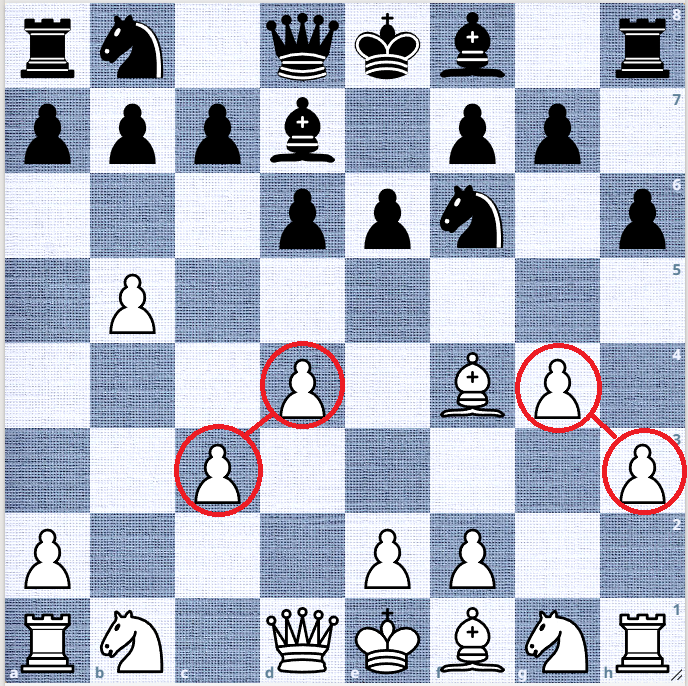
Pawns naturally form structural relationships. One important example is a pawn chain. The Pawn Graph (PG) represents positive structural relationships between pawns.
In the following diagram, h3–g4 and d4–c3 form parts of the PG.
Isolated pawns, doubled pawns, and other structural weaknesses also affect the health of the pawn structure. Flexibility is another important aspect of the PG.
The details of graph scoring and its use in position analysis are developed in the book.
MG — Mobility Graph
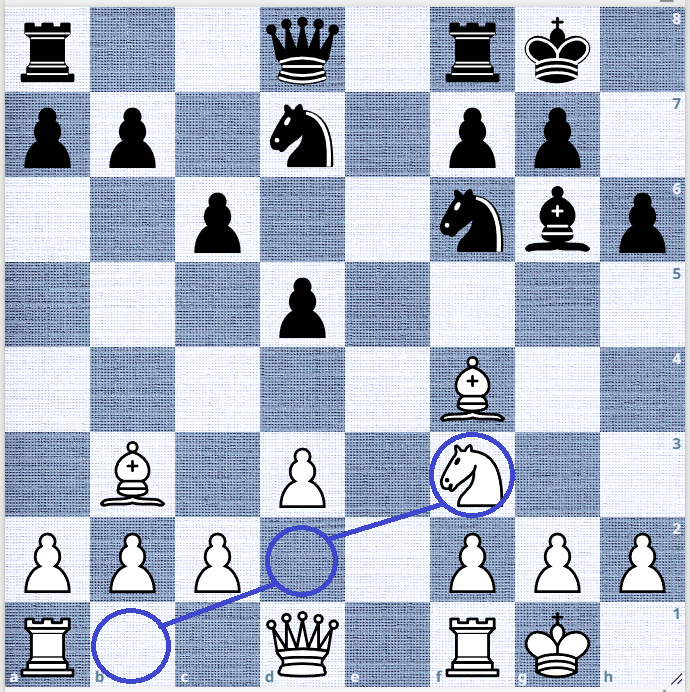
The Mobility Graph (MG) examines a non-pawn piece in its current position. We consider the roles it can perform from where it stands now.
A piece can attack, defend, support other pieces, restrict the opponent, or contribute to a plan.
Every piece except pawns has a Mobility Graph. One important question is:
How many useful roles can a piece perform from its current position?
The more useful roles a piece can perform, the greater its flexibility. This flexibility can be represented through a scoring system.
Future positions are explored through analysis and calculation using graph-based methods.
Graph Chess does not replace traditional chess. The two approaches are complementary, and players can switch between them whenever needed.
CG — Coordination Graph
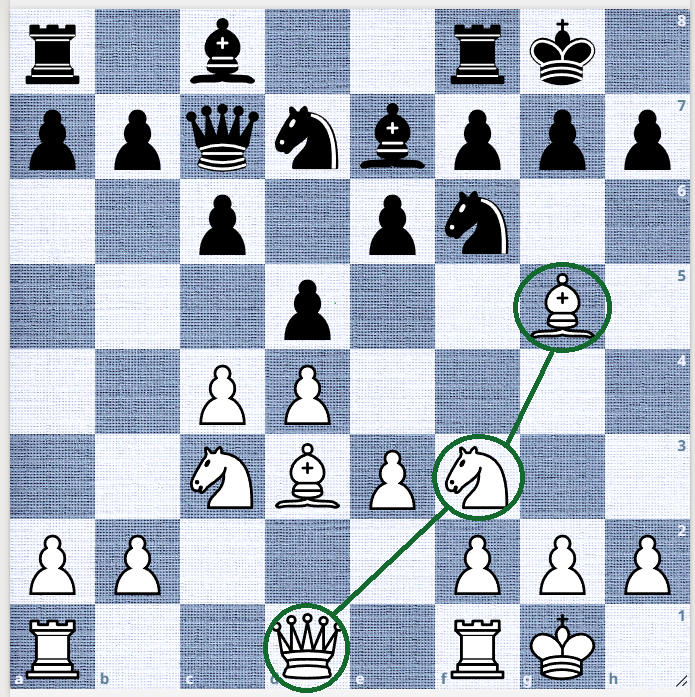
The Coordination Graph (CG) represents supporting relationships between pieces of the same side. These relationships can form a chain of supporting pieces.
A piece in the CG may support another piece while also having its own Mobility Graph (MG). This distinction is important.
In the following position, the knight on f3 supports the bishop on g5. The knight is also supported by the queen, creating a chain of supporting pieces.
The usefulness of the CG depends on how effectively pieces maintain and use their supporting relationships. An overloaded piece may have limited flexibility because it has too many responsibilities.
Tactical disruptions and sacrifices can break connections, requiring coordination to be rebuilt or reorganized.
The detailed scoring and analysis of the CG are developed in the book.
The Book
Coming SoonHidden Graphs of Chess
A Graph-Based Method to Learn and Play Chess
The three graphs provide a new way to look at a chess position. But understanding the graphs is only the beginning.
Hidden Graphs of Chess develops this idea into a practical method for learning and playing chess.
The book explains how the graphs can help players understand positions, identify strengths and weaknesses, generate candidate moves, and guide calculation. It also connects Graph Chess with traditional chess concepts, showing how the two approaches work together.
Worked positions, graph analysis, tactical ideas, and training positions help readers study and practise the method step by step.
Training Positions
Practical chess positions will demonstrate the Graph Chess decision-making process.
About Hidden Graphs of Chess
Hidden Graphs of Chess explores a graph-based approach to understanding chess positions and improving decision-making. Its goal is to complement traditional chess knowledge with another way of seeing the board.